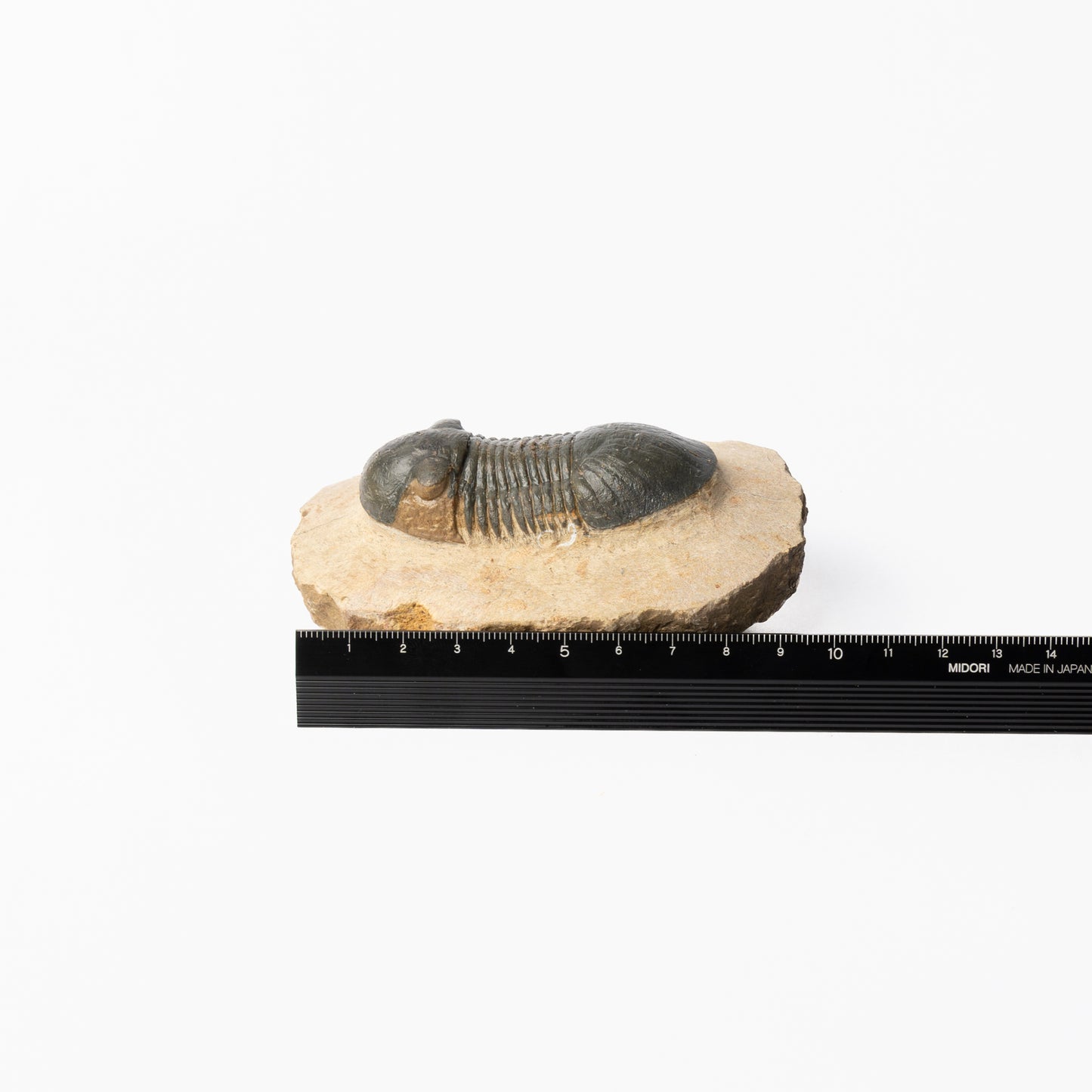


Paralejurus sp. Trilobite
Paralejurus sp. Trilobite
Couldn't load pickup availability
A fine trilobite from Morocco. Although this piece shows a repair line down the middle of the trilobite (most noticeable under UV light) it is stable and not uncommon for pieces from the region
Devonian, Eifelian
Jebel Oufaten, Morocco
405 million years old
Approximately 7cm long on a 10cm x 7cm base.
More about Trilobites
More about Trilobites
Trilobites were an incredibly successful group of ancient marine arthropods that lived in Earth’s oceans for almost 270 million years. They first appeared during the Cambrian Period, around 521 million years ago, and became extinct at the end of the Permian Period, around 252 million years ago.
Their name means “three lobes”, referring to the three lengthwise sections of their body. Trilobites also had a clearly divided body made up of a head section, segmented middle section, and tail section. This distinctive shape makes them one of the most recognisable fossil groups in the world.
Trilobites lived only in the sea and occupied a wide range of environments, from shallow coastal waters to deeper ocean settings. Some species crawled across the seabed, while others could swim or burrow. Many had highly developed compound eyes, making them especially fascinating to collectors and scientists alike.
Because trilobites evolved rapidly and existed for such a long span of geological time, their fossils are very useful for understanding ancient marine ecosystems and dating rock layers. They are found in many parts of the world, including Morocco, the USA, China, Russia, and the UK.
Today, trilobites remain one of the most popular fossils for collectors. Their age, variety, and striking appearance make them a perfect choice for anyone interested in prehistoric life, natural history, or building a fossil collection.
Share